
- Design Ideas
- Cities
- Trends
- Guides
- Price Calculators
- Interior DesignersNEW
- Our Portfolio
- More


- Home
- Interior Design Ideas
- Pooja Mandir Design Ideas
- Marble Finish Pooja Room Design With Shelves


 Facebook
 Whatsapp
 Copy Link


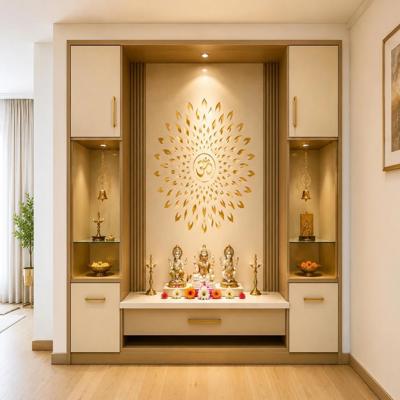



Marble Finish Pooja Room Design With Shelves
Design Specifications:
Style: Contemporary Luxury Minimalist
Unit Dimension(WxDxH): 54x12x96inches
Colour: Statuario White and Grey with Brass Gold Accents
Mount Type: Wall-Tiled with Floating Cantilevered Shelves
Storage Features: 3 floating marble-finish engineered stone shelves at 36, 54, and 72 inches, concealed steel cantilever brackets, horizontal brass strip inlay between shelf levels, optional lower closed cabinet in matching marble finish
Design Features:
- Large-format 1200 x 2400mm Statuario-look porcelain tiles are installed in a book-match pattern - two consecutive tiles are mirror-imaged so the vein pattern flows continuously across the joint - creating the appearance of a single slab of Italian marble at a fraction of the cost and with zero porosity, eliminating the sealing requirements of genuine natural stone.
- Three floating shelves in 25mm engineered Statuario quartz are colour-matched to the porcelain wall tile within the same vein pattern family, creating a unified stone aesthetic across wall and shelves - the quartz is non-porous, acid-resistant, and requires no sealing, making it significantly more practical than natural marble for surfaces that contact kumkum, turmeric, and flower petal juices daily.
- Horizontal 10mm brass strip inlays set into the porcelain tile grout lines between each shelf level add a warm metallic accent that breaks the expanse of white-grey marble surface into visual registers - the brass is solid, not brass-coated, and is polished and lacquered to resist tarnishing in the slightly acidic micro-environment created by incense combustion products over extended periods.
- Concealed heavy-duty steel cantilever brackets are anchored into the masonry wall with M12 anchor bolts behind the tile surface, distributing the shelf load directly into the structural wall without any visible support below each shelf - this creates the levitating shelf illusion that is the hallmark of luxury Indian residential pooja installations shown in premium architecture publications.
- Recessed ceiling spotlights positioned on an arc 18 inches from the face of the marble wall are specified with a 25-degree narrow beam angle that grazes the tile surface from above - grazing light at this shallow angle reveals the three-dimensional texture of the large-format porcelain tiles and accentuates the grey veining, transforming a flat tile wall into a dramatically lit architectural surface.

Warranty

Designs

EMI

Ratings

Modern Compact Pooja Room Design With Elegant Décor

Modern Spacious Pooja Room Design with Peacock Feather Backlight

Modern Floor-Mounted Pooja Unit Design in White and Sandy Fossil

Modern White Pooja Room Design with Golden Handles

Wooden Partition Modern Spacious Pooja Room Design with 3 Step Storage

Modern Pooja Room Design With White Marble And Wooden Partition

Modern Wall-Mounted Pooja Unit Design on White Finish

Modern Pooja Room Design With Three Step Platform

Modern Pooja Room Design With Wooden Fluted Panel

Modern Pooja Design with Fluted Gold Screens and Backlit Arched Niche

Minimal Pooja Design with Arched Bronze Om Symbol and Globe Pendants
Statuario carries bold, high-contrast dark grey veining on a bright white ground - more visually forceful than Carrara's finer grey veining on a cream background. The two are not interchangeable. At night, under artificial lighting during puja, Statuario's stronger pattern holds its presence against the wall rather than fading into the background - which is what makes it the more compelling backdrop for a deity arrangement that needs to read clearly in low-light evening conditions.
No - and that difference is the whole point of specifying it here. Natural marble is porous. It needs annual sealing and acid-free cleaning products, and it still stains from kumkum, haldi, and oil if the sealer is overdue. Porcelain needs a neutral-pH mop for the floor and a microfibre wipe for the wall. That is the complete maintenance requirement - one of the more practical home interior ideas for an Indian pooja space where ritual substances are in contact with surfaces daily.
1200 x 2400mm tiles demand a wall that is perfectly level to a maximum flatness tolerance of 3mm per 2 metres - tighter than standard tile work, and non-negotiable at this format. Skim-plastering to achieve that flatness comes before the adhesive goes on. Two experienced tilers and a mechanical suction lifter are required to handle the 35 to 40 kg weight of each panel. This scope of work reflects stylish modern mandir design standards where wall preparation matters as much as the tile selection.
Soft damp cloth and mild dish soap covers regular cleaning. No metal polish near lacquered brass - it strips the protective coating rather than cleaning through it. A touch-up lacquer pen in brass colour handles small scratches or worn sections. Full relacquering every 8 to 10 years keeps the strips looking right over the long term.
Direct afternoon sun on white Statuario creates glare - not a minor inconvenience but a genuine comfort problem during afternoon puja. A sheer ivory fabric blind on the window addresses it without blocking the light entirely. In a small pooja room design where the sacred wall sits close to the window, that one intervention makes the difference between a space that works at every hour and one that becomes uncomfortable for two hours every afternoon.
Pooja Mandir Design Ideas for You
- Color
- Theme