
- Design Ideas
- Cities
- Trends
- Guides
- Price Calculators
- Interior DesignersNEW
- Our Portfolio
- More


- Home
- Interior Design Ideas
- Pooja Mandir Design Ideas
- Modern Spacious Pooja Room Design With Peacock Feather Backlight


 Facebook
 Whatsapp
 Copy Link





Modern Spacious Pooja Room Design with Peacock Feather Backlight
Design Specifications:
Style: Contemporary Indian Luxe
Unit Dimension(WxDxH): 72x14x108inches
Colour: Deep Teal and Gold with Walnut Brown and White Marble
Mount Type: Wall-Mounted Backlit Panel with Floating Marble Shelf
Storage Features: Floating marble deity shelf on concealed brackets, LED backlight channel with colour temperature control, side walnut panel niches, lower concealed cabinet for pooja accessories
Design Features:
- The peacock feather artwork is hand-painted by a commissioned artist on a 6mm tempered back-painted glass panel in a proprietary water-resistant enamel medium - using glass as the painting substrate rather than canvas or paper allows LED strips mounted behind the panel to transmit light evenly through the artwork without hot spots, making the feather colours appear luminous from within rather than simply lit from the front.
- Peacock motifs hold deep sacred significance in the Krishna devotional tradition - the peacock feather adorning Krishna's crown is among the most widely recognised divine symbols in Vaishnavism, making a peacock feather backlit panel a symbolically appropriate choice for a Krishna mandir that simultaneously functions as a high-impact visual element in a contemporary interior.
- The LED backlight system behind the glass artwork panel uses individually addressable RGBW strips that can be programmed via a smartphone app to display warm amber during morning puja, full-spectrum white for festival days, and a slow colour cycle between teal and gold during evening aarti - giving the mandir a dynamic lighting quality unavailable in fixed-colour installations.
- Walnut wood side panels flanking the backlit artwork are constructed with a shadow gap detail at both the top and bottom edges, allowing the panels to appear to float off the wall surface - a millimetric precision detail that elevates the installation quality from a cabinet finish to an architectural statement consistent with high-end Indian residential projects.
- A solid white Carrara marble floating shelf at 44 inches from the floor is mounted directly in front of the backlit glass panel on heavy-duty concealed steel brackets, allowing the deity arrangement to be silhouetted against the glowing peacock feather background when viewed from across the room - a compositional choice that gives the mandir a museum-quality presentation quality.

Warranty

Designs

EMI

Ratings
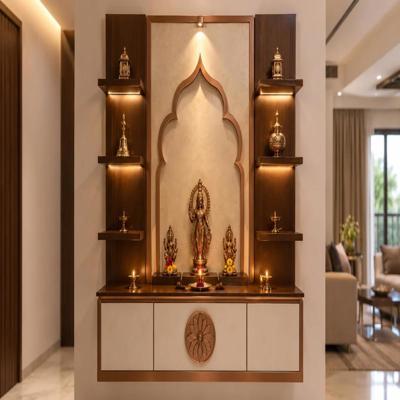
Wall Mounted Bronze and Pearl Modern Pooja Unit Design with Dark Wood Display Shelves

Modern Pooja Room Design With White Marble And Wooden Partition

Modern Pooja Room Design With Wooden Fluted Panel

Wooden Partition Modern Spacious Pooja Room Design with 3 Step Storage

Modern Pooja Mandir Design With A Two-Step Platform

Modern Floor-Mounted Pooja Unit Design in White and Sandy Fossil

Modern Pooja Unit Design with Elegant Floor-Mounted Design

Modern Floor-Mounted Pooja Room With Open Storage

Modern Mandir Design With Wooden And Marble Finishes

Modern Wall-Mounted Pooja Unit Design on White Finish

Modern Compact Pooja Room Design With Elegant Décor
The enamel paint on the tempered glass back panel is fused at 580 degrees Celsius during manufacturing - a process that bonds the pigment into the glass surface rather than sitting on top of it. This makes the artwork impervious to scratching, moisture, incense residue, and cleaning agents, with a functional lifespan equivalent to the glass panel itself, typically 25 to 30 years under indoor conditions.
The RGBW system can be operated in two modes - a standard single warm-white mode controlled via a conventional 5A modular dimmer switch, and a full-colour programmable mode via a Bluetooth or WiFi controller that pairs with a smartphone app. Both controllers are supplied with the unit and a certified electrician is recommended for initial wiring and configuration.
The peacock feather is primarily associated with Lord Krishna and the Vaishnava tradition. For Shaivite or Shakta households, the panel may be replaced with alternative commissioned artwork - lotus for Lakshmi, Nataraja silhouette for Shiva - using the same backlit glass panel format. This tradition-specific flexibility is what distinguishes considered pooja room designs where the deity tradition determines the visual programme, not the other way around.
The fused enamel surface is cleaned with a soft microfibre cloth dampened with clean water or a mild glass cleaner - no abrasive pads or acidic cleaners should be used near the panel edges where the enamel meets the raw glass. The LED strip behind the panel is accessible for replacement by removing two concealed fixing screws at the base - a detail that reflects the standard Interior Company's home interior design applies to all installations where lighting must be serviceable without dismantling the artwork.
The backlit peacock feather panel is designed to be viewed from a minimum distance of 8 feet for the full artwork to be taken in. The ideal installation has a clear floor-to-mandir distance of at least 10 to 12 feet - a spatial requirement that applies to a full pooja room but can also be met in a well-planned small mandir design alcove within a 3BHK living room where a 10-foot viewing distance is available.
Pooja Mandir Design Ideas for You
- Color
- Theme