
- Design Ideas
- Cities
- Trends
- Guides
- Price Calculators
- Interior DesignersNEW
- Our Portfolio
- More


- Home
- Interior Design Ideas
- Pooja Mandir Design Ideas
- Modern Pooja Room Design With Wooden Fluted Panel


 Facebook
 Whatsapp
 Copy Link





Modern Pooja Room Design With Wooden Fluted Panel
Design Specifications:
Style: Architectural Minimalist
Unit Dimension(WxDxH): 48x12x96inches
Colour: Natural Teak with White Quartz Shelf
Mount Type: Wall-Mounted Fluted Panel with Floating Shelf
Storage Features: Floating quartz deity shelf with cantilevered bracket, slim brass wall-mounted spotlight, lower wall-mounted closed cabinet with fluted front to match panel
Design Features:
- Vertical fluted panels are CNC-routed from 18mm solid teak planks with a 20mm ridge pitch - a proportion that creates visually deep shadow lines at typical room lighting angles, giving the mandir backdrop a richly textured, three-dimensional quality that flat veneered panels cannot produce regardless of how complex the grain beneath them is.
- Natural teak finish is achieved through a hand-applied teak oil and hard wax blend that deepens the wood's inherent honey-gold and dark-brown grain contrast without forming a surface film - the texture of the fluted ridges stays fully tactile rather than being sealed behind a glossy layer, and the finish improves with each annual maintenance coat rather than degrading.
- A 30mm thick white engineered quartz floating shelf provides stark chromatic contrast against the warm teak backdrop, making the deity and ritual objects the undisputed visual centrepiece of the composition - the quartz is specced in a veined Calacatta design that references marble without the porosity and maintenance challenges that natural stone would bring to a daily-use pooja shelf.
- A slim adjustable brass spotlight mounted on a wall track above the shelf allows beam angle and direction to be repositioned without tools - as the deity arrangement changes across different festivals, the light follows it precisely, which fixed recessed downlights simply cannot do.
- Lower cabinet fronts are manufactured with matching fluted teak panels, carrying the vertical rhythm from floor to ceiling without a break. Pooja accessories disappear behind doors that read as a continuation of the decorative wall rather than as a separate furniture piece inserted below it. The result is an architectural intervention rather than a product.

Warranty

Designs

EMI

Ratings
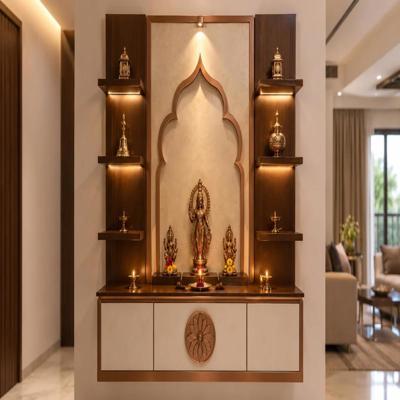
Wall Mounted Bronze and Pearl Modern Pooja Unit Design with Dark Wood Display Shelves

Modern Spacious Pooja Room Design with Peacock Feather Backlight

Modern Pooja Room Design With White Marble And Wooden Partition

Wooden Partition Modern Spacious Pooja Room Design with 3 Step Storage

Modern Pooja Mandir Design With A Two-Step Platform

Modern Floor-Mounted Pooja Unit Design in White and Sandy Fossil

Modern Pooja Unit Design with Elegant Floor-Mounted Design

Modern Floor-Mounted Pooja Room With Open Storage

Modern Mandir Design With Wooden And Marble Finishes

Modern Wall-Mounted Pooja Unit Design on White Finish

Modern Compact Pooja Room Design With Elegant Décor
The care is similar to a flat wood surface with one additional step - the grooves between ridges collect dust and incense soot faster than a flat face. A soft-bristle paintbrush drawn along the channels weekly keeps them clear. For the annual coat, use a brush rather than a cloth - a cloth rides the ridge tops and leaves the groove interiors dry, which defeats the purpose of oiling fluted work entirely.
For daily pooja use, quartz wins - full stop. Kumkum, sindoor, turmeric, and lamp oil sit on its surface rather than soaking in, because quartz is non-porous by nature. Marble is beautiful but it needs acid-free sealing every 12 to 18 months just to keep up with that same daily contact, and a missed cycle shows. Quartz needs only a neutral pH wipe-down to maintain its appearance - one of the more practically sound home interior ideas for a pooja shelf in an Indian home where daily ritual use is not an occasional event.
Yes - fluted panels can go directly over existing flat ceramic tiles using construction adhesive and mechanical anchoring at the top and bottom, provided the tiles are firmly bonded and the total wall projection of 12 to 18mm is acceptable. Over textured or uneven tiles, a thin plywood battening system is installed first - a preparation step that good interior design practice for wall-mounted sacred installations always includes.
Wall space is the binding constraint - you need at least 48 inches of dedicated width and 90 inches floor to ceiling for the panels, shelf, and lower cabinet to work together as intended. Standing space in front matters too; a 6 by 6 foot room gives you enough room to sit, stand, and move through the aarti without feeling pinched. That footprint fits what most people would call a small pooja room design in an Indian apartment - a dedicated room, just not a large one.
Teak has a long track record in sacred construction - across South Indian temples specifically, it has been the structural and decorative timber of choice for centuries, and Vastu Shastra regards it highly for exactly the qualities that make it useful: natural oils that resist pests, a long stable grain, and an inherent density that holds carved and fluted work cleanly over decades. Bringing that material into a home context isn't a decorative choice so much as a continuation of the same tradition - which is what makes this a genuinely considered mandir design for home rather than something that simply looks the part from a distance.
Pooja Mandir Design Ideas for You
- Color
- Theme